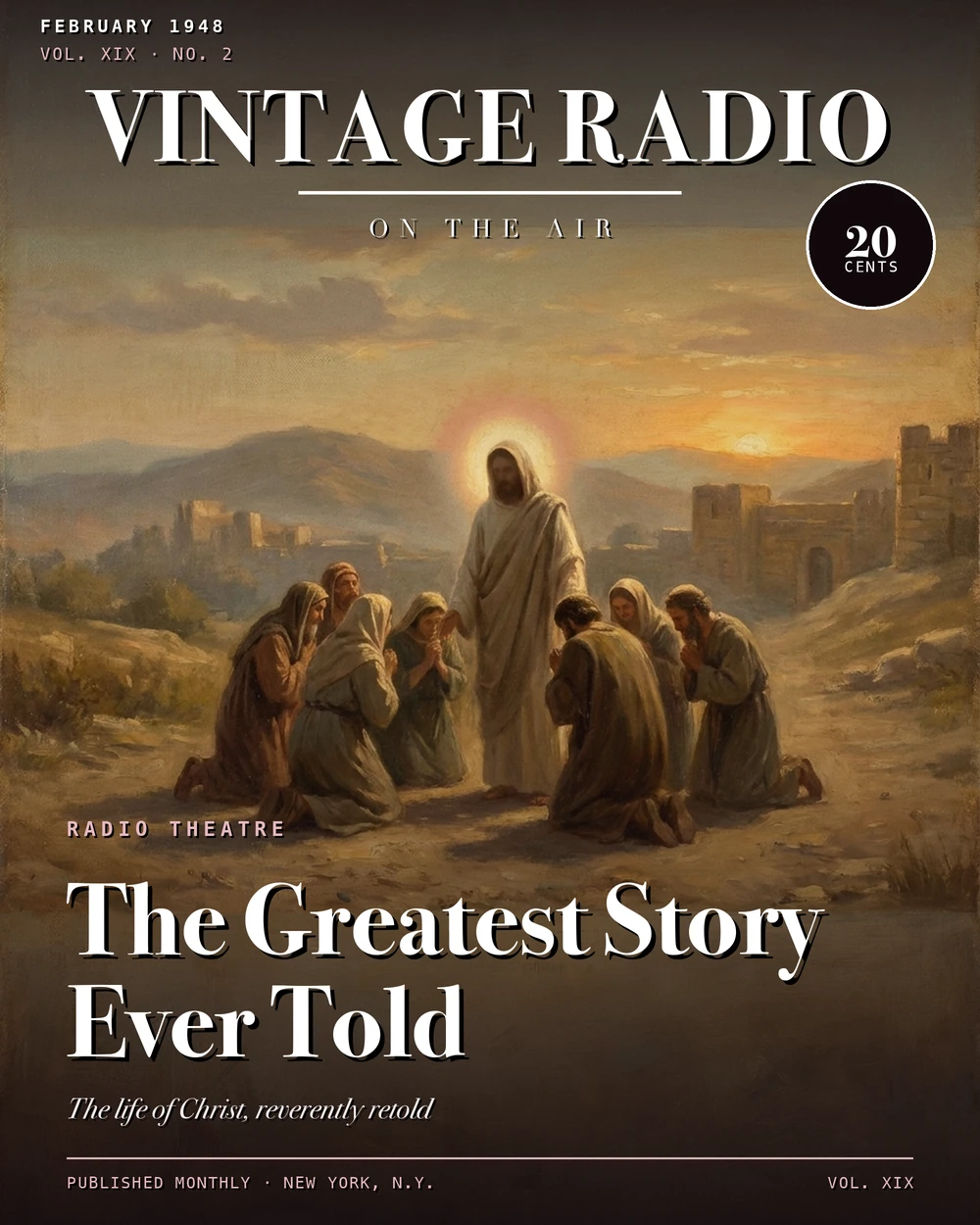
The Greatest Story Ever Told
A First Nobody Was Sure They Should Attempt
When The Greatest Story Ever Told premiered on ABC on January 26, 1947, it did something no radio series had done before: it gave a continuing, speaking voice to Jesus Christ. The producers knew exactly what they were taking on. They were uneasy about it, and they didn't rush in. Before a single episode aired, they consulted many scholars and assembled an interdenominational advisory board to guide the production. The premiere itself reflected that deliberation — Fulton Oursler personally chose "Parable of the Good Samaritan" as the opening episode, feeling its lesson against intolerance would make the right starting point. What came out of that cautious process was a Sunday afternoon program that would run nearly a decade, every week, thirty minutes, until December 30, 1956.
The series was based on Oursler's book of the same name, a dramatization of Christ's life drawn from the four Gospels, and Oursler served as writer-consultant throughout the run. Henry Denker handled the week-to-week writing, meeting with Oursler weekly before scripts were prepared. Their method was consistent: start with a modern problem, find its corollary in the life of Christ, and build the episode around that theme. Many of the half-hours were original modern parables illustrating New Testament texts; others — notably the five Nativity scripts and the three Easter episodes — were drawn directly from the book. It gave the show a grounded quality, attempts to connect ancient events to the concerns of mid-century American life rather than simply staging biblical pageant pieces.
How They Handled the Voice
The single most delicate creative decision the production faced was how to present Christ's voice on air. Their answer was careful and deliberate. Warren Parker played the role — the only continuing character in the cast — but he played it in complete anonymity. There were no cast credits. No pictures were taken of the performers at work. Parker simply showed up, did the work, and went uncredited, week after week, for the full run of the series.
His voice was given a slight echo effect, described as producing perhaps the same effect as a halo in a work of art — a subtle signal to the listener that this voice was set apart, without veering into anything theatrical or sensational. And crucially, no dialogue was invented for Christ. Every word spoken by the character was drawn directly from the Bible. The writers and consultants held firm to that rule across the entire run of the show.
The Sound of the Thing
This was not a spare production. The weekly budget ran to $7,000, supporting original scores by William Stoess performed by a full studio orchestra of 35 pieces and a 16-voice chorus. Later, Jacques Belasco and then Willard Young led the orchestra, with Young also directing the chorus. Announcer Norman Rose opened and closed each episode. Terry Ross handled sound effects, and the effects work was praised specifically for its faithfulness to the period — sandal sounds were simulated prolifically, and animal noises were recorded on location at the Bronx Zoo rather than pulled from generic library effects. Marx Loeb directed, with Leonard Blair as assistant director, and Loeb assembled the cast from Broadway actors for each episode. Wadill Catchings produced.
There was no studio audience. There were no commercials in the conventional sense — just a simple tag at the end reminding listeners that the program came to them from Goodyear Tire and Rubber Company, included only because FCC requirements made it necessary. Goodyear's involvement traced back to mid-1946, when James H. S. Ellis of the Kudner Agency brought chairman Paul W. Litchfield aboard after Oursler and Catchings made their pitch. When the broadcast run finally ended, the arrangement was described as one of the longest institutional broadcast advertising campaigns in radio history.
What the Critics and the Ratings Said
The reception came quickly. On February 9, 1947 — barely two weeks after the premiere — New York Times critic Jack Gould called the series "a program of extraordinary beauty and reverence, which without reservation may be listed as one of the most significant ethereal achievements in recent years," describing it as "a rare and successful fusion of religion, art and commerce." City College of New York honored it as the best radio program created and broadcast in 1947. In 1949 came a special George Foster Peabody Citation, which praised the program for maintaining "such a high degree of religious integrity, and has been so free of denominational bias or prejudice, that it has won the acclaim of newspapers, magazines, trade journals, and religious leaders alike."
The Nielsen story is more interesting than a single number suggests. In the 1946–47 season, opposite Kate Smith on CBS and Bob Burns on NBC, the show averaged a 3.6 against their 9.8 and 9.4. The following season both competitors were cancelled, and The Greatest Story Ever Told leapt to 8.9 — a 250 percent improvement. New competition from Ozzie and Harriet, Percy Faith, and Nick Carter pulled the number back to 6.4 in 1948–49, though a December 1948 repeat of the Advent series scored a 10.8. On September 18, 1949, ABC moved the show from 6:30 to 5:30 Sunday afternoons, where it stayed until the end.
Reach Beyond the Broadcast
In some parts of the country, the program became integrated into school and church curricula — not just background listening, but material communities were actively using. Beginning July 25, 1948, the World Wide Broadcasting Foundation carried the show via shortwave to 58 other countries. In 1950, ABC pressed more than 5,000 albums of selected episodes for distribution; half went to the Protestant Radio Commission, which sent them to ministerial groups and councils of churches, and half to the National Council of Catholic Men, which placed them in Catholic orphanages, hospitals, and schools. The U.S. Armed Forces Radio and Television Service pressed vinyl discs of episodes for forces stationed overseas; those discs, along with associated acetates, are now held in the Library of Congress Motion Picture, Broadcasting, and Recorded Sound Division.
The series moved into other media as well. On December 2 and December 23, 1951, ABC-TV broadcast two television episodes — "The Story of Lazarus" and "No Room at the Inn." The following year CBS picked up rights for a half-hour television version, again sponsored by Goodyear, with Billboard reporting one Sunday afternoon broadcast each in April, May, and June 1952. Years later, when George Stevens directed the 1965 United Artists feature film starring Max von Sydow, Henry Denker's radio scripts received screenwriting credit over and above the Oursler book.
Fulton Oursler and What He Left Behind
Charles Fulton Oursler — born in Baltimore in 1893, dead of a sudden heart attack in New York in May 1952 — was a working journalist, playwright, and editor who had supervised Bernarr Macfadden's magazines from 1921 to 1941 and become a senior editor at Reader's Digest in 1944. Raised in a devout Baptist family, he had declared himself an agnostic at fifteen; he and his family converted to Roman Catholicism in 1943, following a 1935 tour of the Holy Land. He also wrote detective fiction under the pseudonym Anthony Abbot, and wrote on magic and spiritualism as Samri Frikell — a pen name stitched together from the magicians Samri Baldwin and Wiljalba Frikell.
His book The Greatest Story Ever Told, published by Doubleday in 1949, grew directly out of the radio series, and by the time it appeared his name was known nationwide. The book went through scores of reprints. He followed it with The Greatest Book Ever Written in 1951, and The Greatest Faith Ever Known, completed by his daughter April Oursler Armstrong and published posthumously in 1953. Oursler did not live to see the full popular success of his writings, or the 1965 film, or the four more years the radio program would continue without him. The show kept running on the foundation he and Denker had built — week after week, drawn from scripture, every word of Christ taken from the Gospels — until December 30, 1956.